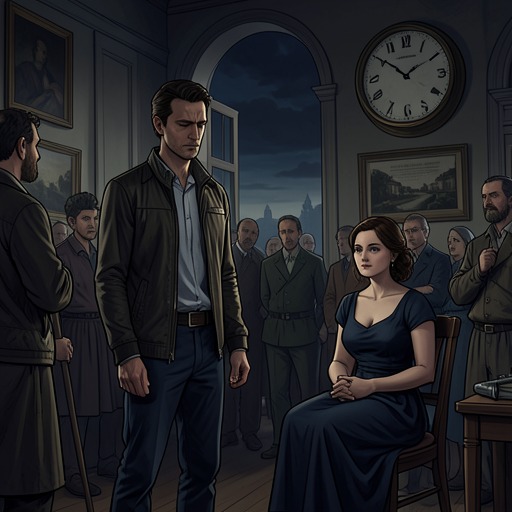
Saladin Chamcha’s arrest and transformation
The Satanic VersesSaladin Chamcha’s arrest and transformation turn a mistaken identification into a crisis of legal and bodily identity. After the Bostan disaster, he is taken from Rosa Diamond’s house by police searching for a suspected illegal arrival; during the arrest and transport, he discovers horns and other goat-like changes. His explanation of who he is meets ridicule, while his transformed body is treated as evidence against him. The episode makes his status precarious in two ways at once: the authorities do not believe his account, and the visible change gives their disbelief an apparent confirmation.
Background and the beach search
Saladin is staying at Rosa Diamond’s home after reaching the beach in the aftermath of the Bostan’s destruction. He is alone in an unfamiliar bedroom when he breaks down in anger, striking at the pillow and complaining bitterly about the people involved in his experience. The police arrive at that moment. Their appearance is not the result of an investigation into the air disaster: an anonymous telephone call has reported a suspicious person on the beach, and the search has been organized around the possibility of an illegal arrival from a fishing boat.
The scale of the response makes the misidentification consequential before Saladin is even found. Fifty-seven uniformed constables, drawn from several coastal towns, search the beach with thirteen dogs. At Rosa’s house, five constables guard possible exits while three immigration officers wait with them. The procedure treats a report about a possible trespasser as grounds for a large, coordinated search. Rosa, who has gone outside with a garden hose, is caught between the present police operation and memories of wartime blackouts: under the seven floodlights, she briefly loses her grip on the distinction between then and now. Her disorientation gives the search an additional historical echo without changing what the officers believe they are looking for.
Identification, disbelief, and arrest
When Rosa’s challenge brings the police into view, the immigration officers react to Saladin as soon as he appears in her hallway. He is wearing borrowed striped pyjamas, holding them up after a button has come off, and rubbing one eye. The men point him out to the others, treating his presence as the resolution of their search. Saladin tries to explain that he has survived the explosion of the Bostan and come ashore, not entered Britain from a fishing boat. The officers answer his account with laughter and jokes about his having fallen from the sky and swum to shore.
Saladin insists that he is British and has the right of abode, but he cannot produce a passport or other identifying document. His claim therefore has no immediate documentary support, and the officers treat the absence as grounds for further disbelief. He tries another way to make himself recognizable, invoking his professional television identity, but the claim is met with another joke rather than verification. Rosa attempts to intervene, yet the press of police and dogs prevents her from following what is happening to him. The scene’s imbalance is practical as well as verbal: Saladin is surrounded, his explanations are difficult to hear, and the crowd’s amusement overwhelms his effort to establish what has happened.
Gibreel Farishta comes downstairs from the room where he has been staying, dressed in Henry Diamond’s maroon smoking jacket and jodhpurs. He watches the proceedings from the landing. As Saladin is handcuffed and led toward the police van, barefoot and still clutching his pyjamas, he calls on Gibreel to explain the truth. The arrival of a witness does not, in the scene provided, resolve the officers’ suspicion. Saladin is taken away, and the encounter with Gibreel leaves the arrest marked by an appeal for help that has not yet secured recognition.
The transformation in custody
In the police van, the officers pull Saladin’s pyjamas down and discover that his body has changed. He sees thick, tightly curled hair on his thighs; his thighs are unusually broad and strong, while the hair stops below the knees and his lower legs narrow toward cloven hooves. The new horns keep catching against the van’s interior and the officers. Saladin responds first with disbelief and then with a hysterical giggle, while the officers turn the changes into a source of jokes. Their amusement makes the transformation harder to communicate as an emergency: what is unprecedented to him is treated by them as a spectacle.
Saladin wonders whether he died in the Bostan explosion and is experiencing an afterlife, or whether he is gravely ill and delirious in hospital. A kick makes those explanations less reassuring, and he returns his attention to the sealed van, its three immigration officers and five policemen. The scene does not settle whether the metamorphosis is supernatural or part of some other altered experience. It does, however, insist on the immediate reality of his fear and confinement. When the officers later accuse him of behaving like an animal, his changed body becomes a pretext for further humiliation rather than a reason to reconsider his account.
Saladin eventually identifies himself by his full name, Salahuddin Chamchawala, and his professional name, Saladin Chamcha. He also gives details that could be checked, including his memberships and car registration, and asks the officers to consult the computer. One of them challenges the idea that his name could belong to an Englishman and calls attention to his appearance; Saladin counters by pointing out that the immigration officers themselves do not sound Anglo-Saxon. The exchange exposes the gap between his effort to establish identity through records and the officers’ reliance on racialized assumptions about how an Englishman should look or sound.
Hospital, confinement, and significance
Saladin wakes in a hospital bed coughing green fluid from his lungs. A physiotherapist, Hyacinth Phillips, tells him he has a mild case of pneumonia and begins treatment. The illness leaves him weak, but the episode also complicates the police officers’ own account: later, Stein says that Saladin’s lung condition made the story more convincing and explains why he had passed out. Stein also tells him that Rosa has been found dead in her bed and that Gibreel has vanished; the possibility of foul play, he says, has not been eliminated. These disclosures show how little control Saladin has over what is known or recorded about the night, even after he has reached a medical setting.
Stein advises Saladin not to make a complaint, arguing that his horns and hooves would make him an unreliable witness. The warning turns bodily difference into a barrier to redress: the evidence of his mistreatment, and the person seeking to describe it, are both made to seem incredible. The arrest thus extends beyond the mistaken beach search. It places Saladin in custody, subjects him to ridicule, and leaves his account vulnerable to dismissal precisely because his transformation is so visible.
The episode also establishes a pattern that continues beyond the van. Later, when Hal Valance dismisses Saladin from The Aliens Show, Valance describes the problem through the show’s supposed ethnic audience and the racial profile Saladin brings to it. That later professional rejection is not presented as a direct consequence of this arrest, but it echoes the same conflict between Saladin’s chosen English identity and the categories imposed on him. At Rosa’s house, the authorities ask for documents and then read his body as proof that he does not belong; in the television business, his perceived racial identity becomes a commercial liability. The transformation gives this conflict a fantastic shape, while the arrest grounds it in the ordinary power of institutions to decide whose explanation counts.